
YOUR SHOT AT TEAM USA STARTS HERE.

GameRun's analysis is part of the NTIS application process. And it's much more than a one-time report. Athletes use it to get feedback, run GameRun drills multiple times a week, and track their progress over time.

“When players use GameRun consistently throughout the season, parents and coaches can really see the progress happening over time. That's what makes it so powerful.”

Founder & COO, Pro Stocks Royal

JEFF SCHAEFER

“When players use GameRun consistently throughout the season, parents and coaches can really see the progress happening over time. That's what makes it so powerful.”

—JEFF SCHAEFER, Founder & COO, Pro Stock Royals

GameRun is the the analysis platform behind NTIS, scouts, college, and pro paths


From your phone to NTIS in 3 steps

How to turn one short video into detailed hitting or pitching analysis, personalized feedback, and an NTIS-ready report.

Step 1

Capture your game

Record a short 1-2 minute clip of hitting or pitching from your phone. Need tips on how to record? Go here.

Step 2

Get Your Analysis
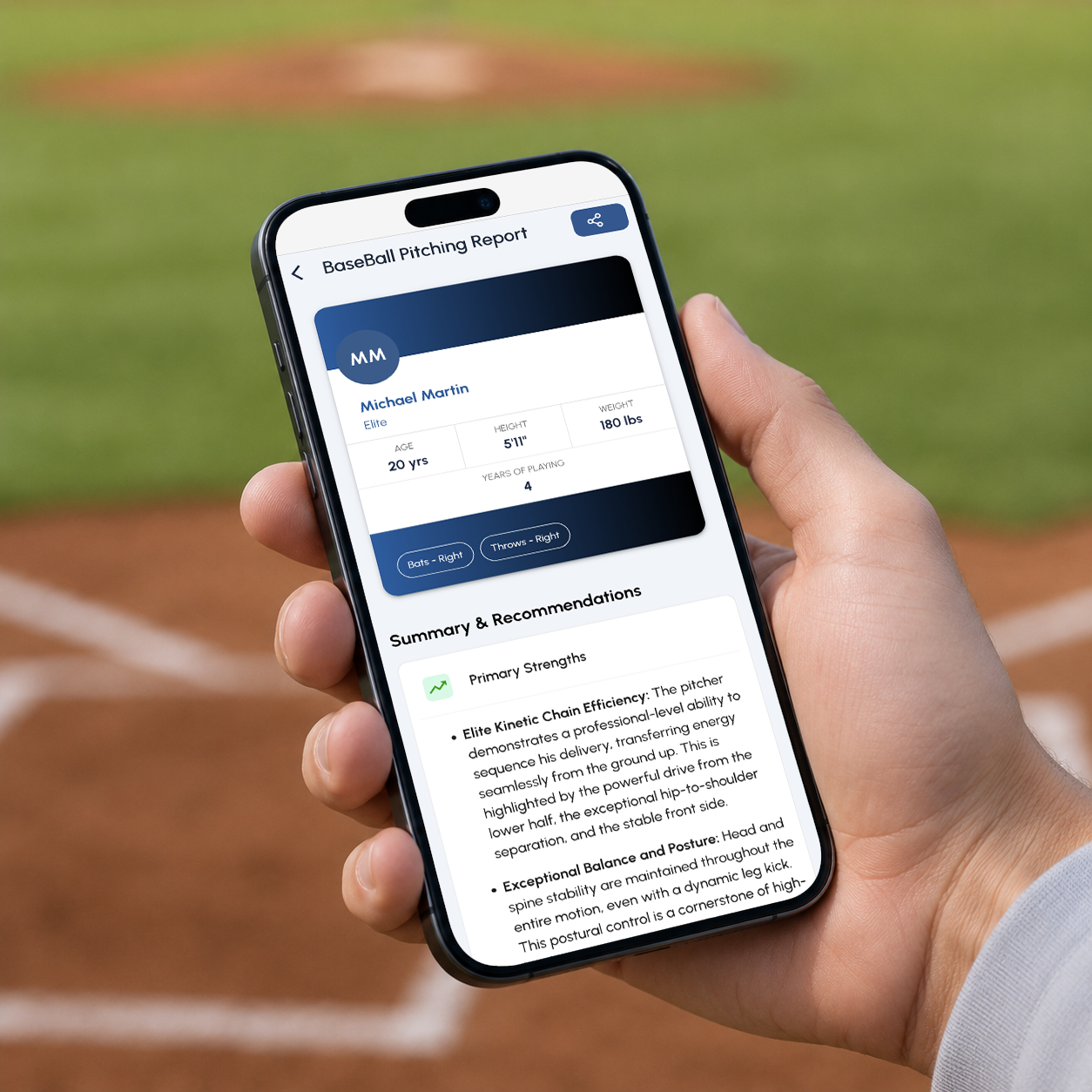
Go to GameRun, select baseball, and upload your clip. Your GameRun Report, including personalized analysis, feedback, and development insights, is ready in minutes.

Step 3

Share Your Analysis Report
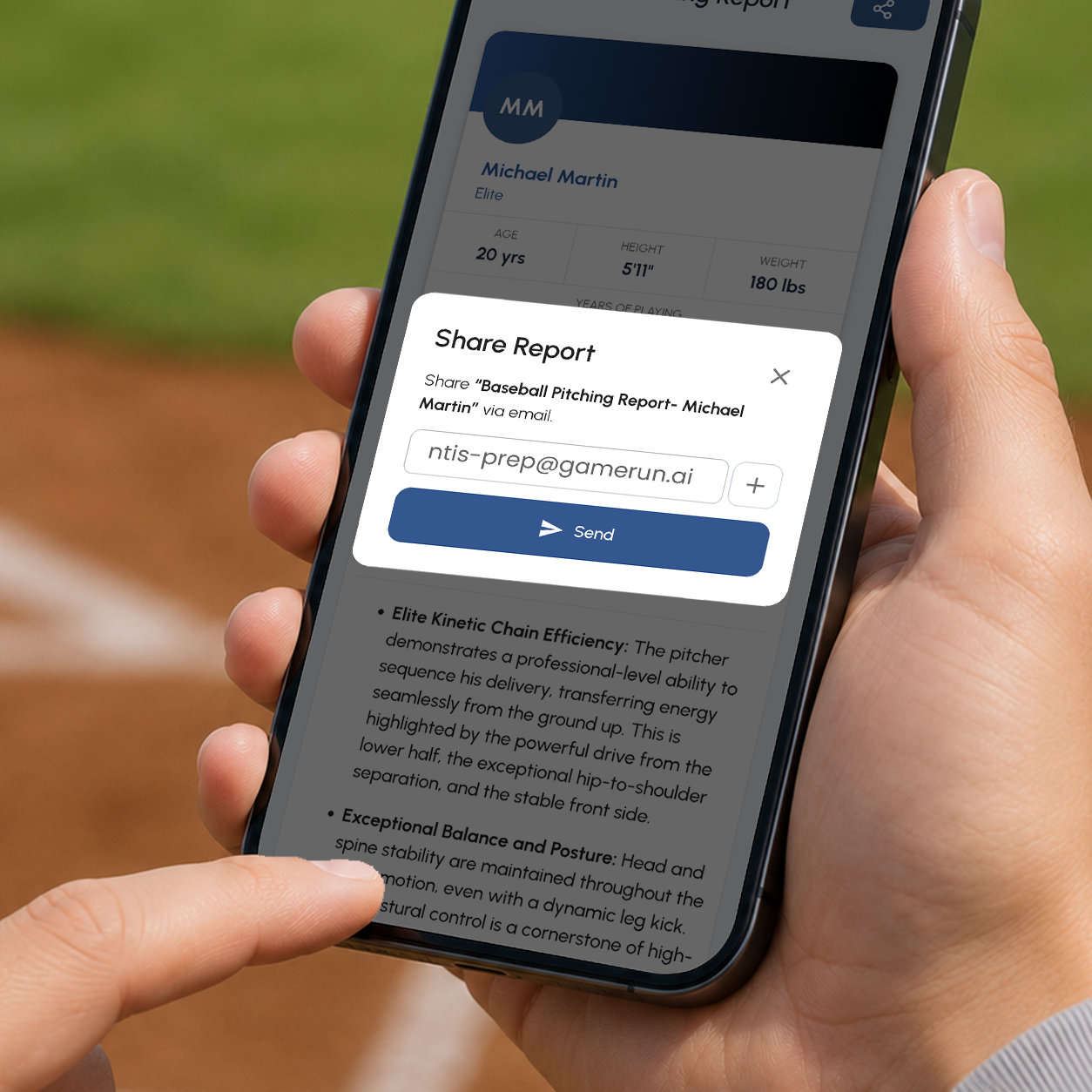
Upload and share your analysis report to review performance insights, key metrics, and personalized recommendations efficiently.

GameRun · Baseball Analytics Report

Overall Summary

Strengths
Strength 1: Excellent head discipline and ball-tracking ability, remaining still through contact.
Strength 2: Maintains solid balance and establishes a firm front leg to rotate against.
Areas For Improvement
Improvement 1: Shorten the swing path by keeping hands inside the ball and avoiding 'casting'.
Improvement 2: Improve front side control to prevent the front shoulder from opening prematurely.

Hitting Mechanics Evaluation

Fundamental Assessment
14 components evaluated · Average 3.2 / 5
6 Strong
4 Developing
4 Weak
ComponentRatingCoach's Notes
Head Position5/5Excellent. Head remains still and level from stride through contact, showing great discipline and ball tracking.
Stance4/5Athletic and balanced starting position. Slightly open stance is functional and allows for good vision.
Stride & Timing3/5Timing mechanism is a simple leg lift which is consistent, but lacks dynamic energy creation.
Balance at Foot Strike4/5Lands in a stable and balanced position, ready to initiate rotation. Good control.
Load & Separation3/5Achieves some separation between hands and torso, but could create more torque with a more dynamic load.
Hip Drive3/5Hips initiate the swing sequence correctly, but the rotation lacks explosive power.
Front Leg Stability4/5Front leg firms up effectively, providing a solid post to rotate against.
Hand Position4/5Starting hand position is good, high and in a powerful launch spot.
Posture4/5Maintains good athletic posture and spine angle throughout the swing.
Staying Centered3/5Maintains center of gravity well, with only a slight forward drift during the swing.
Front Side Control2/5Front shoulder pulls open early, causing the back side and barrel to drag through the zone.
Swing Mechanics2/5The swing sequence is disconnected due to early front side opening and hand casting.
Bat Path2/5Bat path is long and looping due to 'casting' the hands away from the body.
Hands Inside Ball2/5Hands get away from the body early, preventing a tight, connected swing.
Advanced Assessment
6 components evaluated · Average 3.5 / 5
2 Strong
4 Developing
ComponentRatingCoach's Notes
Palm Up / Palm Down3/5Achieves a decent palm up/palm down position at contact, but can be more consistent with a tighter swing path.
Bat Extension3/5Extension is limited due to the rotational nature of the swing and early casting.
Head at Contact5/5Elite head position. Head is perfectly still and down on the ball at the point of contact.
Back Shoulder Drop4/5Back shoulder works under the front shoulder appropriately, creating a functional swing plane.
Barrel in Zone3/5Barrel gets in the zone but the entry is somewhat steep and the path is not as long as it could be.
Plate Coverage3/5Appears to cover the middle of the plate well, but the long swing path may create holes on inner and outer thirds.

Recommended Drills

1
Fence Drill (or Connection Ball Drill)
Focus
Keeping Hands Inside Ball
Execution
Stand facing a fence, just far enough away that a good swing won't hit it. Take dry swings, focusing on keeping your hands tight to your body. If the bat hits the fence, your hands are casting out. A connection ball between the biceps also works to promote this.
2
Opposite Field Hitting (Front Toss)
Focus
Front Side Control
Execution
Take front toss with the goal of hitting every ball to the opposite field. This forces the hitter to let the ball travel deeper, which naturally keeps the front shoulder closed longer and promotes a good inside-out path.
3
Stride and Hold Drill
Focus
Stride Sequencing
Execution
Go through your load and stride, but pause completely at foot strike. Check your position: are your hands back? Is your front shoulder still closed? From this stopped position, initiate the swing. This isolates the rotational phase and helps feel the proper sequence.

Summary & Recommendations

Strengths
Elite Kinetic Chain Efficiency: The pitcher demonstrates a professional-level ability to sequence his delivery, transferring energy seamlessly from the ground up.
Exceptional Balance and Posture: Head and spine stability are maintained throughout the entire motion, even with a dynamic leg kick.
Powerful Lead Leg Block: The front leg acts as a firm post upon landing, effectively halting forward momentum and enabling an explosive transfer of rotational energy.
Areas For Improvement
Maintaining Complex Rhythm: The unique, multi-part leg lift is currently a source of rhythm and power. The primary challenge is ensuring this complex movement remains perfectly repeatable under fatigue and pressure to avoid timing disruptions. Focus should be on maintaining this high-level consistency.

Pitching Mechanics Evaluation

1 · Head Posture
Levelness
The head remains exceptionally stable and level from leg lift through ball release, with no discernible lateral tilt.
Direction
Eyes and head are locked on the target throughout the delivery, with no premature pulling off to the glove side, promoting consistent command.
2 · Leg Lift & Stride
Leg Lift Height
Employs a high, controlled leg lift that brings the thigh past parallel, coupled with a unique rhythmic pause before initiating forward movement.
Stride Phase Distance
Achieves a long and powerful stride, estimated to be over 100% of body height, directed precisely toward home plate.
3 · Balance & Foundation
Balance at Front Foot Strike
Exhibits elite balance at front foot strike, with the head positioned over the body's center of gravity. The lead foot lands firmly, establishing a stable base before the upper body begins its rotation.
4 · Separation & Torque
Lead and Separation
Generates significant hip-to-shoulder separation. At foot plant, the hips are open and rotating toward the plate while the shoulders remain closed, creating maximum torque.
Lead Hand Direction
The glove hand and arm are tucked tightly and efficiently into the chest, facilitating powerful torso rotation without flying open early.
5 · Power Generation & Transfer
Hip Drive
Demonstrates explosive back hip drive, with the back knee rotating down and forward efficiently.
Trunk (Upper Body)
The kinetic chain is sequenced effectively, transferring energy from the ground, through the legs and core, into the upper body and arm.
6 · Landing & Release
Posture at Landing
The lead leg braces firmly upon landing, creating a strong blocking action that stops forward momentum and transfers it up into the ball.
Front Leg — Lockout or Bent
At front foot strike, the throwing arm is in an ideal position (approx. 90-degree elbow flexion), demonstrating excellent timing and reducing arm stress.
7 · Follow Through
Arm Follow Through
The arm follows a full and unrestricted path of deceleration, extending toward the plate and finishing across the body near the opposite leg — a key indicator of a safe and efficient motion.

Overall Rating

Mechanics Assessment Score
Based on 5 components · Strong 9.5 / 10
Mechanical Component
Rating (1–10)
Comments
Lower Half Mechanics
10/10
Explosive, efficient, and well-directed. The foundation of the entire delivery..
Hip/Shoulder Separation
10/10
Textbook execution of creating and utilizing torque. This is the primary engine for velocity.
Upper Body/Arm Action
9.5/10
Clean, fluid, and well-timed arm action that syncs perfectly with the lower body rotation.
Balance & Posture
10/10
Exceptional stability from start to finish, demonstrating elite body control.
Kinetic Chain Efficiency
10/10
A model of seamless energy transfer, with each segment of the delivery building on the last.
Overall Grade
9.5/ 10
The mechanics evaluated are of an elite, professional caliber. They demonstrate an extremely high level of efficiency, power generation, and repeatability. The focus for a pitcher with these mechanics shifts from correction to maintenance and physical conditioning to support the high-output delivery.

Recommended Drills

1
Towel Drill (with a focus on Lead Leg)
Purpose
To reinforce the feeling of a strong, bracing front leg and prevent the knee from collapsing or absorbing energy.
Execution
Perform a normal pitching motion with a towel instead of a ball. Focus intensely on the moment the front foot lands. The lead leg should plant firmly, stopping all forward momentum. The goal is to feel the "thud" of the landing and the subsequent rapid rotation of the hips and torso.
2
Walk-in Throw Drill
Purpose
To maintain the feel of linear momentum converting into rotational power and to reinforce hip/shoulder separation.
Execution
Start several feet behind the rubber. Take two or three walking/shuffling steps forward (like a crow hop) into your throwing motion. This exaggerates the feeling of moving your center of mass toward the target and sequencing the rotation correctly.
3
Balance Point Mirror Drill
Purpose
To ensure the complex leg lift remains a controlled and repeatable movement pattern.
Execution
Facing a mirror, go through the initial phase of the delivery up to the peak of the leg lift and pause. Hold the balance point for 3–5 seconds. Check in the mirror for postural stability, head levelness, and consistent positioning of the lift leg. This reinforces muscle memory for the most unique part of the delivery.

FEATURED STORY

“FROM FIRST ANALYSIS TO NTIS REGIONAL IN TWO WEEKS”

“GameRun gave us the kind of breakdown you’d expect from a full coaching staff. We were able to analyze swing mechanics and pitching details in minutes instead of hours.”

Jason Miller

18 Year Old, Pitcher • New York

“Our players were immediately more engaged once they started seeing their own performance broken down visually. It made feedback more real and easier to understand.”

— Laura Jenkins, Youth Academy Texas

“The pitching analysis was insanely detailed—release point, balance, timing—things I never noticed before. It’s like having a personal pitching coach.”

— Ethan Rodriguez, High School Pitcher

Common Questions

FAQ

  • USA Baseball Operations and Regional Directors review NTIS submissions alongside the GameRun analysis. It is the standard mechanics report attached to your profile.

  • Most analyses are delivered within 48 hours of upload. Submission windows can run faster during peak NTIS periods.

  • 1080p at 60fps gives the most accurate biomechanical tracking, but standard smartphone footage from a clean angle is fully supported.

  • GameRun currently supports baseball athletes across the NTIS age groups. Additional sports are rolling out through the next selection cycle.

  • Yes. Every report comes with a shareable link and a downloadable PDF formatted for coaches and recruiters.

  • Each region runs its own selection window. The next regional cutoff is shown on the GameRun dashboard once you sign in.

Your NTIS analysis is one upload away.

Most athletes finish the GameRun step in under five minutes of active time. Most come back after the NTIS submission to see what's changing.