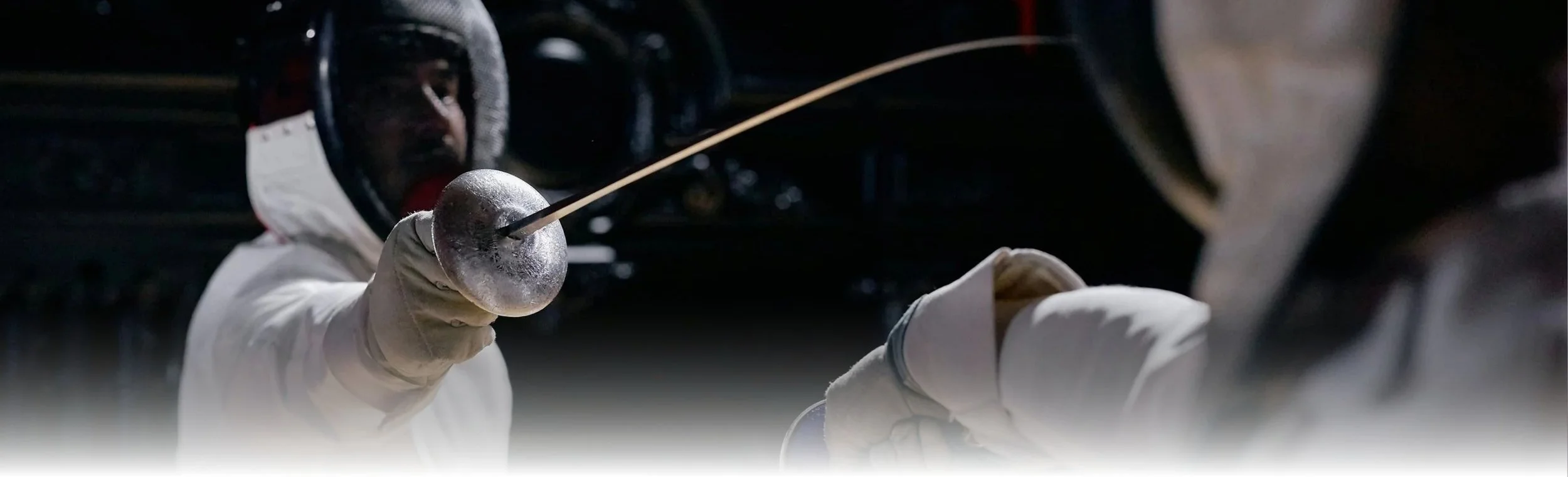

Get Detailed Fencing Game Analysis

Player Information:
Name: Samarth Kumbla (Left Fencer) and Ben Shih (Right Fencer)
Postion: Erasyl- Right
Position: Kanat- Left
Weapon: Epee
Overview & Initial Assessment
High-level bout context and initial read.
1. General Observations
The bout is contested between KANAT (Left) and ERASYL (Right).
The match is characterized by a high frequency of double touches, indicating that both fencers have an offensive mindset and very similar timing.
The score remains close throughout the bout, showing a tightly contested match.
KANAT (Left): Exhibits a patient and reactive style. He relies on distance control, invites ERASYL to attack, and scores with counter-attacks or attacks into preparation. His footwork is measured and controlled.
ERASYL (Right): Demonstrates an aggressive and proactive style. He initiates most offensive actions using powerful lunges and fleches to close distance quickly. His objective is to apply constant pressure and force openings.
2. Initial Assessment of Strengths and Weaknesses
KANAT Strengths:
Excellent distance and timing control
Strong counter-attacks and attacks into preparation
Effective use of opponent’s aggression
Composed under pressure
KANAT Weaknesses:
Can be caught by explosive deep attacks
Occasional slow retreat leading to double touches
ERASYL Strengths:
Powerful and explosive lunges and fleches
Strong at creating offensive pressure
Forces actions through aggression
ERASYL Weaknesses:
Over-commitment due to aggression
Vulnerability to counter-attacks and stop-hits
Attacks fall short when poorly prepared
3. Weapon Identification
Weapon: Epee
Entire body is valid target
No right-of-way rules apply
Double touches awarded within 40 milliseconds
Identified by bell-shaped guard and stiff blade
Technical Execution
Blade work, attack mechanics, and footwork quality.
A. Blade Work
1. Point Control
KANAT: Demonstrates strong point control, especially on small targets like foot and wrist. Attacks into preparation are precise. Example: foot touch to make the score 2–1.
ERASYL: Point control is effective on committed torso attacks. Precision decreases during fast actions or counter-attacks due to speed.
2. Parries (Blade Skill)
KANAT: Uses parries as a last defensive layer. Parry-riposte at 11–11 was clean and decisive. Prefers circular parries such as circle-six.
ERASYL: Parries less frequently. Uses simple lateral parries (four/six). Ripostes are often late, resulting in double touches.
B. Attack Execution
1. Types of Offensive Actions
KANAT: Straight attacks, attacks into preparation, simple beat-attacks. Used a fleche at 3–3.
ERASYL: Straight attacks, beat-attacks, frequent fleches to apply pressure.
2. Attacks with Lunge
Both fencers use the lunge as a primary attacking action. ERASYL’s lunge is deeper and more powerful.
3. Advance-Lunge & Fleche
KANAT: Uses advance-lunge selectively to close distance. Fleche used sparingly.
ERASYL: Frequently uses advance-lunge and fleche. Example: fast running attack to make score 6–7.
4. Attack Preparation Time
KANAT: Longer preparation using footwork and blade presence to find correct timing.
ERASYL: Short, explosive preparation relying on speed and surprise.
C. Footwork
1. Efficiency, Speed, and Agility
KANAT: Efficient, controlled footwork focused on distance management.
ERASYL: Explosive and fast, allowing long-distance attacks but affecting recovery balance.
2. Balance
KANAT: Maintains balance consistently.
ERASYL: Can become overextended after deep attacks.
Tactical Awareness
Distance management, initiative, and weapon strategy.
A. Distance Management
1. Maintaining Ideal Distance
KANAT: Excels at maintaining ideal distance. Forces ERASYL to fully commit before attacking, enabling effective counter-actions.
ERASYL: Strong at closing distance quickly but weaker at maintaining fencing distance. Focuses on breaking distance rather than managing it.
2. Recognizing Opponent’s Range
KANAT: Understands ERASYL’s maximum lunge and fleche range. Uses timed retreats to make attacks fall short.
ERASYL: Aware of KANAT’s range but misjudges it at times, leading to counters or attacks into preparation.
B. Right of Way (Epee Context)
1. Priority Rules Application
Epee does not use right-of-way rules. Whoever hits first scores. Double touches are awarded within 40ms.
2. Seizing Initiative
KANAT: Seeks timing rather than initiative. Lets ERASYL start actions and scores with precise counters.
ERASYL: Seeks constant initiative through aggression, resulting in both single and double touches.
C. Weapon Strategy
1. Attack and Defense Patterns
KANAT: Defensive-to-offensive pattern: retreat, invite attack, counter to hand/foot.
ERASYL: Offensive pattern: press forward, beat blade, deep lunge or fleche to torso.
2. Adjustments to Opponent
KANAT: Adjusts well to aggression, setting traps through distance.
ERASYL: Makes minimal adjustments and continues aggressive strategy throughout.
Timing
Attack and counter timing analysis.
A. Attack Timing
1. Appropriateness of Initiation
KANAT: Attacks during opponent preparation. Example: foot touch at 2–1.
ERASYL: Uses speed and aggression to create attack moments.
2. Timing Relative to Opponent
KANAT: Second-intention fencing.
ERASYL: First-intention fencing.
B. Counter Timing
1. During Opponent Preparation
KANAT: Signature skill. Counters during opponent movement.
ERASYL: Counters mostly at final extension.
Overall Strategy & Bout Management
Score-based decisions and mental control.
A. Bout Management
1. Strategy Based on Score
KANAT: Becomes more patient when ahead. At 14–13, prepares winning counter.
ERASYL: Strategy unchanged regardless of score.
2. Momentum Shifts
KANAT: Regains control using fundamentals.
ERASYL: Responds by increasing aggression.
B. Tactical Adaptation
1. Adjustments During Bout
KANAT: Targets foot, adjusts retreat timing.
ERASYL: No significant adjustment.
2. Under Pressure
KANAT: Calm and composed.
ERASYL: Reverts to basic power attacks.
Location of Touches
Body targets and strip positioning.
A. Body Targets
KANAT: Foot, wrist, arm, torso.
ERASYL: Mostly torso.
B. Strip Location
KANAT: Scores mid-strip and near own end.
ERASYL: Scores by pushing opponent to end line.
Additional Detailed Analysis
Action success, preparations, and vulnerabilities.
A. Action Effectiveness
KANAT Success
Counter-attacks and attacks into preparation.
KANAT Failure
Surprise tempo breaks.
ERASYL Success
Explosive lunges and fleches.
ERASYL Failure
Telegraphed long attacks.
B. Preferred Actions
KANAT: Counter-attacks.
ERASYL: Beat-lunge, fleche.
C. Preparations
KANAT: Subtle footwork and blade presence.
ERASYL: Strong beats and advances.
D. Vulnerabilities
KANAT: Sudden tempo changes.
ERASYL: Preparation and recovery.
Comparative Analysis
Observed bout vs elite epee standards.
Efficiency
KANAT closer to elite efficiency.
Risk Management
High double-touch rate vs elite standards.
Tactical Depth
Straightforward aggression vs reaction.
Point Control
Elite fencers show higher precision.
Comparison Chart
Side-by-side attribute comparison.
Style: KANAT reactive | ERASYL aggressive
Strength: KANAT timing | ERASYL power
Weakness: KANAT speed | ERASYL predictability
Footwork: KANAT controlled | ERASYL explosive
Adaptation: KANAT high | ERASYL low
Fencing Scorecard
Point-by-point progression.
Multiple early double touches.
KANAT gains advantage mid-bout.
Final score: 15–13.
Winning touch: Counter-attack vs fleche.