What If My Kid Isn't a Natural Skater?
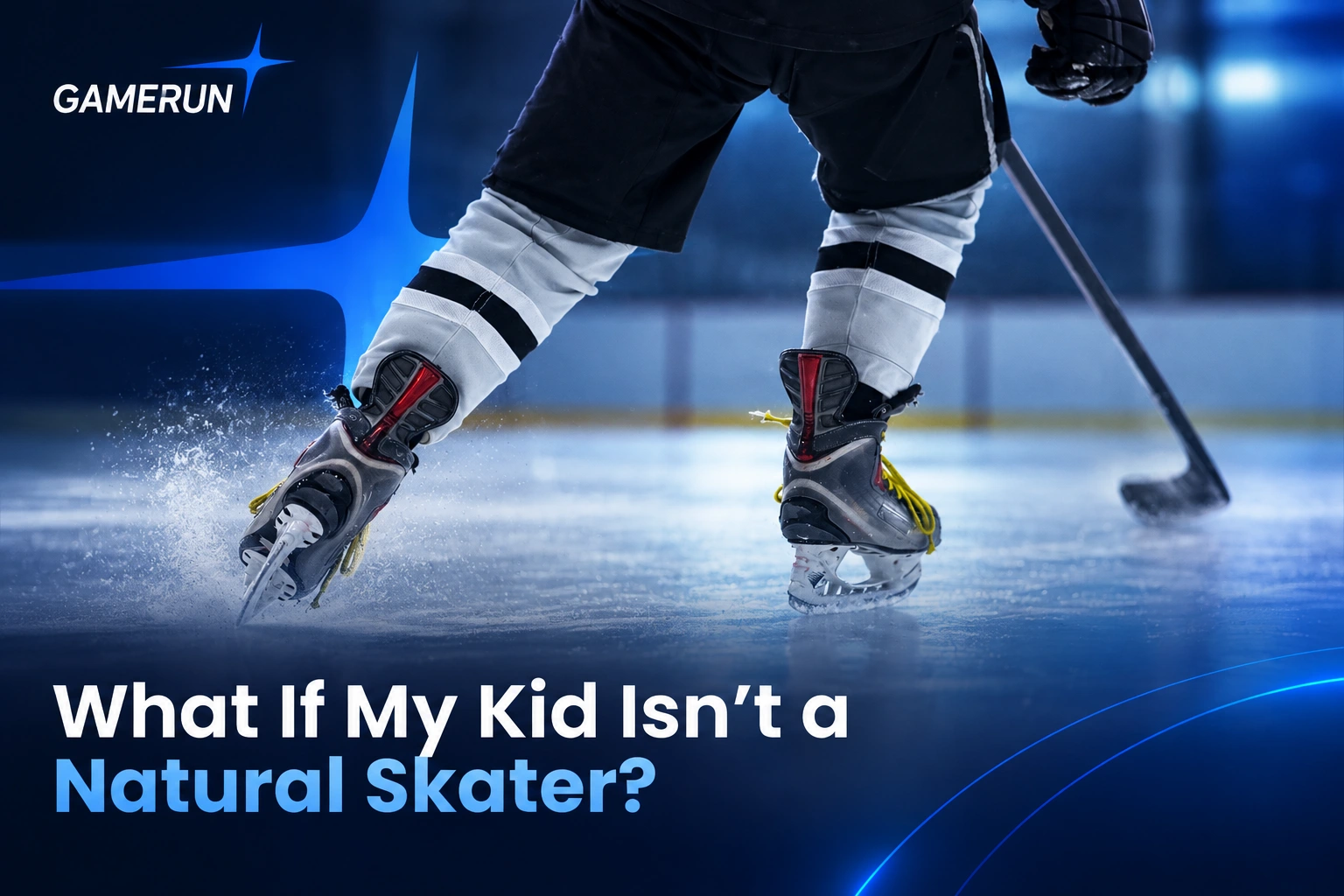
You watch it happen every practice. One kid pushes off and moves like the ice is doing the work for him. Your kid is still fighting for balance, a half-stride behind on every race to the puck. And you wonder if this is something your kid can catch up to, or is it something you either have or you don't? Brendan Shaw, has been coaching for 27 years and has been around the game since he started playing at age four. He has heard the question from a lot of parents.
His answer is that nobody’s born a skater. "Natural athleticism can be a factor, sure,” says Shaw, “But skating is a skill. Skills get better when a kid works at the skill and wants and is willing to learn."
When Shaw started playing hockey, he went through learn-to-skate programs. His parents did not know how to skate. There was no head start in his house. He learned from zero, and along the way, learned that he loved ice hockey.
The kid who looks like a natural might have a hidden advantage: age
Here’s something parents at the rink may not know. Most North American youth hockey programs group athletes by birth year. So a child born on January 1 and a child born on December 31 can compete in the same division, even though the January child is basically a year older. At eight or ten years old, age differences can translate into very clear variations in physical development, coordination and experience on the ice. Parents may mistake this for natural ability.
Researchers call this the “relative age effect,” which was coined by a landmark 1985 hockey study. Some of the earliest sports research on the phenomenon came from hockey, but it has also been identified as true in football, rugby, tennis, basketball and gymnastics, according to the study. The pattern is consistent: children born in the early months of the selection year are overrepresented on elite teams, and children born late in the year are more likely to drop-out of the sport.1
Parents should understand that what they may perceive as “natural ability” may partly reflect a developmental head start. It might also be important to explain this to their athlete.
The head start does not decide who makes it
If early advantage fully determined long-term performance, late-born players would remain behind at the highest levels of the sport. Interestingly, that is not the case.
A study of elite players across eight seasons at the NHL found a very interesting fact about this age variation at the highest levels of hockey. In an article titled, “The Relative Age Effect Reversal Among the National Hockey League Elite,” the authors examined NHL player data across eight consecutive seasons. “Players born in the last quarter of the year (October-December) score more and command higher salaries than those born in the first quarter of the year.”2
At the 90th percentile of scoring, the researchers estimated that fourth-quarter-born players scored approximately nine more points per season than comparable first-quarter-born players. At the 90th percentile of salary, late-born players were estimated to earn 51% more. (But, late-born players remained underrepresented in the NHL overall.)
One explanation is an “underdog effect”: relatively younger players may develop greater resilience, motivation or skill to overcome their early disadvantage. Another possibility is selection itself: the late-born players who successfully advanced may have needed exceptional ability to make it through a system that initially favored their older peers.
What actually builds skating
Shaw's prescription is not complicated. "You get better at skating by skating. Hard work, and being willing to learn," Shaw says. "Where a kid starts doesn't decide where they finish."
The research on how elite players developed points the same direction, with one addition that may surprise parents. The successful players logged serious hours in structured coaching. and they also spent a large share of their childhood on unstructured ice, skating pond hockey, participating in open skate, and playing pickup games with no drill sheet. The two were not alternatives. Technique comes from coaching. The feel for the game comes from playing. For a parent whose kid is behind on skating, the practical version is simple: more time on the ice, in both forms.3
Skating is the floor, not the ceiling
Shaw treats skating as a requirement, not an achievement. It is what makes everything else possible. The two things he watches for after that are “hockey IQ” and competing. Hockey IQ, in his framing, is understanding how to play as part of a team instead of as an individual. It is knowing where to be when the puck is somewhere else.
Competing means being willing to win every one-on-one battle while you are playing the sport. He sees the sport is a series of one-on-one battles. His point is that even with players involved in a game, the outcome keeps coming down to individual matchups happening all over the sheet. These, he emphasized, are learnable skills.
What to tell a developing athlete
If an athlete is behind on skating, they’re behind on a skill, likely at an age when the gap between kids has more to do with birth month and ice time than with anything permanent.
“Where a kid starts doesn't decide where they finish,” Shaw says. “If they love the game, are willing to work and keep learning, you will be surprised by how far they can go. I’ve seen it happen. The athlete you think may not make it, turns out, after hard work, a focus on skills, and an abundance of pure passion, in the NHL. I’ve seen it. Some of them were my players.”
- "Exploring Relative Age Effects in Youth Ice Hockey Through a Single Team Case Study and Composite Narratives," Frontiers in Sports and Active Living, 2021. Original documentation of the effect in hockey: Barnsley & Thompson, 1985.
- "The relative age effect reversal among the National Hockey League elite," PLOS ONE, 2017. Roster data, 2008–09 through 2015–16 seasons.
- Soberlak, P., & Côté, J. (2003). "The Developmental Activities of Elite Ice Hockey Players." Journal of Applied Sport Psychology, 15(1).